
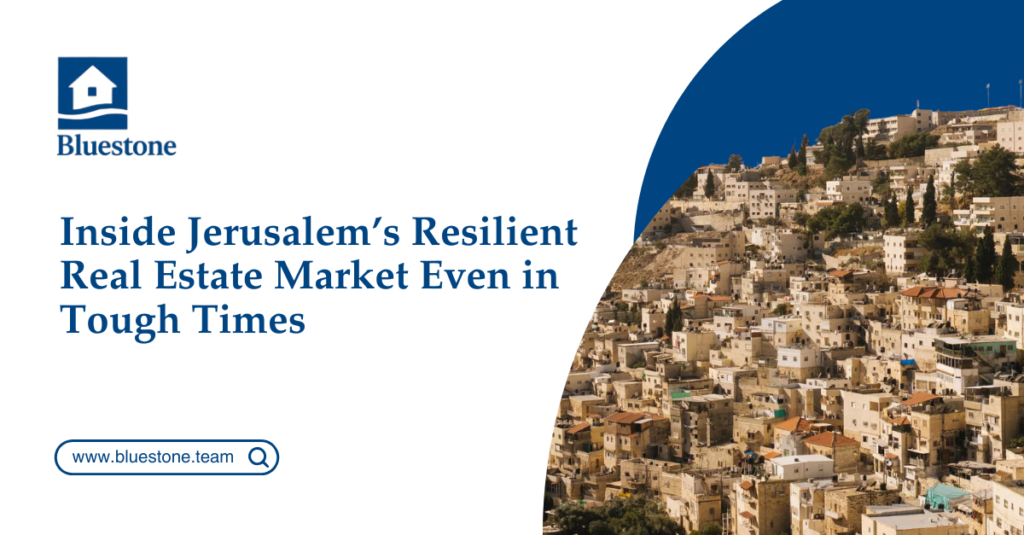
Inside Jerusalem’s Resilient
Real Estate Market Even in Tough Times
Jerusalem’s real estate market has earned a reputation for resilience that sets it apart from nearly every other property market in Israel. While national cycles fluctuate, interest rates rise and fall, and security or economic uncertainty impacts buyer confidence elsewhere, Jerusalem continues to demonstrate remarkable stability. Prices tend to hold. Demand remains present. Long term value persists.
This durability is not accidental. Jerusalem’s housing market is shaped by forces that go far beyond employment data, short term investor behavior, or conventional real estate cycles. Cultural significance, religious connection, demographic trends, supply limitations, and deeply rooted ownership patterns all combine to create a uniquely defensive market profile.
Understanding why Jerusalem real estate performs differently helps buyers, investors, and long term planners make informed decisions, especially during periods when broader markets feel uncertain. This article explores the structural reasons behind Jerusalem’s resilience and explains why the city continues to attract committed buyers even in challenging times.
A Demand Base Rooted in Long Term Commitment
Unlike most global cities, demand for Jerusalem property is not driven primarily by job creation or speculative investment. While local employment plays a role, a substantial portion of buyers are motivated by factors that are far less sensitive to economic cycles.
Many purchasers view property ownership in Jerusalem as a long term personal commitment rather than a financial trade. Buyers are often motivated by religious connection, family legacy, lifestyle alignment, or future residency plans. These motivations reduce the likelihood of panic selling during downturns and create a demand base that remains present even when sentiment weakens elsewhere.
Market data supports this dynamic. Buyer activity in Jerusalem remained comparatively strong even as transaction volumes softened across other regions of Israel, reinforcing the city’s defensive characteristics according to Easy Aliyah’s Jerusalem real estate market report for the first quarter of 2025. easyaliyah.com
International buyers further strengthen this stability. Diaspora purchasers, particularly from North America, Europe, and the United Kingdom, tend to approach Jerusalem property with a multi decade horizon. Many are less affected by short term interest rate movements or domestic Israeli economic pressures. Jerusalem property is often viewed as a store of value, a future home, or a generational asset rather than a tactical investment decision, as highlighted by continued foreign buyer activity reported by the Jerusalem Post.
This layered demand profile makes Jerusalem fundamentally different from markets where buyers enter and exit based on financial cycles alone.
Structural Supply Constraints That Limit Downside Risk
One of the most powerful stabilizing forces in Jerusalem’s real estate market is limited housing supply. Unlike cities that can expand outward or rapidly approve large scale developments, Jerusalem faces structural constraints that restrict new construction.
Historic preservation rules protect large portions of the city. Strict zoning regulations limit building height and density in many neighborhoods. Geographic boundaries and political considerations further restrict expansion. These factors combine to create a persistent imbalance between demand and available housing.
Israel Central Bureau of Statistics data consistently shows that housing starts and completions in Jerusalem lag behind population growth and buyer demand even when national construction activity increases, Jerusalem’s supply growth remains relatively muted.
This supply discipline acts as a natural shock absorber during downturns. When demand softens temporarily, the lack of excess inventory prevents sharp price corrections. Owners are rarely forced to compete aggressively on price because replacement supply is limited and underlying demand remains present.
Market analysis confirms that this structural imbalance continues to support pricing, particularly in established neighborhoods near the city center, according to Israel real estate market trend reporting by Semerenko Group.
In practical terms, Jerusalem simply does not build enough housing to experience prolonged oversupply. That reality underpins long term price stability.
Price Behavior Compared With the National Market
Jerusalem’s resilience becomes even more apparent when compared with broader national housing trends. While Israel’s real estate market has experienced cooling periods, transaction slowdowns, and selective price adjustments, Jerusalem consistently shows shallower corrections and faster stabilization.
Residential price indices published by the Israel Central Bureau of Statistics indicate that when prices soften nationally, Jerusalem tends to outperform most districts in terms of stability and recovery speed.
In contrast, markets such as Tel Aviv and central Israel often experience sharper price movements during periods of uncertainty. These areas are more sensitive to investor activity, financing conditions, and employment trends. When sentiment shifts, price volatility tends to follow.
Jerusalem benefits from a different ownership structure. A large percentage of homeowners are end users rather than leveraged investors. Many have strong equity positions and long term intentions, which reduces forced selling during economic stress. The Bank of Israel has noted that ownership patterns in Jerusalem contribute to market resilience and reduced volatility.
This ownership behavior supports a higher price floor. When fewer sellers are pressured to exit, prices tend to stabilize more quickly even if transaction volumes temporarily decline.
Neighborhood Level Dynamics Drive Market Strength
Jerusalem is not a single uniform market. Its resilience is reinforced at the neighborhood level, where demand patterns remain consistent even during broader slowdowns.
Prime central neighborhoods such as Rehavia, Talbiya, the German Colony, and Baka continue to attract both local and international buyers due to their location, architectural character, walkability, and lifestyle appeal. These areas typically experience limited inventory and strong buyer competition, which helps sustain pricing.
Market commentary from the Jerusalem Post highlights that these neighborhoods tend to recover quickly following market pauses and maintain higher price floors than peripheral areas.
At the same time, urban renewal zones provide a complementary layer of resilience. Areas such as Kiryat HaYovel, Katamonim, Armon HaNatziv, and the Pat Junction corridor are benefiting from infrastructure upgrades, transportation improvements, and redevelopment programs. These neighborhoods continue to attract long term buyers seeking future appreciation rather than short term gains.
Urban renewal activity has supported steady buyer interest even during cautious periods, according to Easy Aliyah’s analysis of Jerusalem neighborhood trends
The combination of established premium neighborhoods and emerging renewal zones creates a diversified demand base that strengthens the overall market.
Rental Demand Provides an Additional Layer of Stability
Jerusalem’s rental market plays a critical role in supporting real estate resilience. Rental demand remains consistently high due to a unique mix of students, religious institutions, diplomats, government employees, and families waiting to purchase.
This demand creates strong occupancy rates and reliable income potential for property owners. Even when sales activity slows, owners often have the option to rent rather than sell under pressure.
The Bank of Israel reports that rental occupancy levels in Jerusalem rank among the highest in the country, reinforcing the city’s role as a stable rental market
Strong rental fundamentals reduce the likelihood of distressed sales and provide owners with financial flexibility during uncertain periods. Easy Aliyah’s Jerusalem rental demand overview further notes that consistent rental absorption supports long term price stability.
For investors and owner occupants alike, this rental safety net adds another dimension of market defense.
Demographics and Population Growth Support Long Term Demand
Jerusalem’s population dynamics further reinforce housing demand. The city has one of the highest population growth rates in Israel, driven by natural growth, internal migration, and international immigration.
Large family sizes, particularly in religious communities, create ongoing demand for housing. At the same time, younger populations entering the housing market sustain baseline activity even during slower economic cycles.
These demographic realities ensure that housing demand remains structurally present. Unlike markets that rely heavily on migration tied to employment cycles, Jerusalem’s growth is anchored in long term residency patterns.
As population increases while supply remains constrained, pressure on housing availability continues, reinforcing price stability over time.
Cultural and Emotional Value Shapes Buyer Behavior
Jerusalem’s real estate market cannot be fully understood through financial metrics alone. The city carries cultural, religious, and emotional significance that influences buyer behavior in ways uncommon elsewhere.
For many buyers, owning property in Jerusalem represents a connection to heritage, faith, and identity. This emotional dimension often leads to higher tolerance for market fluctuations and longer holding periods.
Properties are frequently retained across generations rather than traded opportunistically. This behavior reduces turnover and reinforces scarcity, especially in central neighborhoods.
As a result, Jerusalem real estate functions as both a financial asset and a symbolic one, which further stabilizes demand during challenging times.
Why Jerusalem Continues to Attract Long Term Buyers
Taken together, Jerusalem’s resilience is not the result of a single factor but rather the convergence of multiple reinforcing dynamics. Demand is diversified and deeply rooted. Supply is structurally limited. Ownership patterns favor stability. Rental demand remains strong. Demographics support ongoing absorption. Cultural significance influences long term commitment.
These fundamentals explain why Jerusalem consistently weathers periods of uncertainty better than many other markets in Israel.
For buyers seeking long term security rather than short term volatility, Jerusalem continues to stand apart as one of the country’s most dependable property markets.
Final Thoughts
Jerusalem’s real estate market has proven its resilience across economic cycles, security challenges, and national slowdowns. Prices tend to stabilize more quickly. Demand remains present even when sentiment weakens elsewhere. Structural constraints limit downside risk.
For those focused on long term ownership, generational planning, or capital preservation, Jerusalem offers a market shaped by fundamentals that extend far beyond economics alone.
In a real estate landscape often driven by speculation and volatility, Jerusalem continues to demonstrate why it remains one of Israel’s most enduring and reliable property markets.
You Might Also Be Interested
Browse and read more of Bluestone Insights
Jerusalem Real Estate Outlook 2026 What Buyers and Investors Need to Know Jerusalem continues to…
Inside Jerusalem’s Resilient Real Estate Market Even in Tough Times Jerusalem’s real estate market has…