
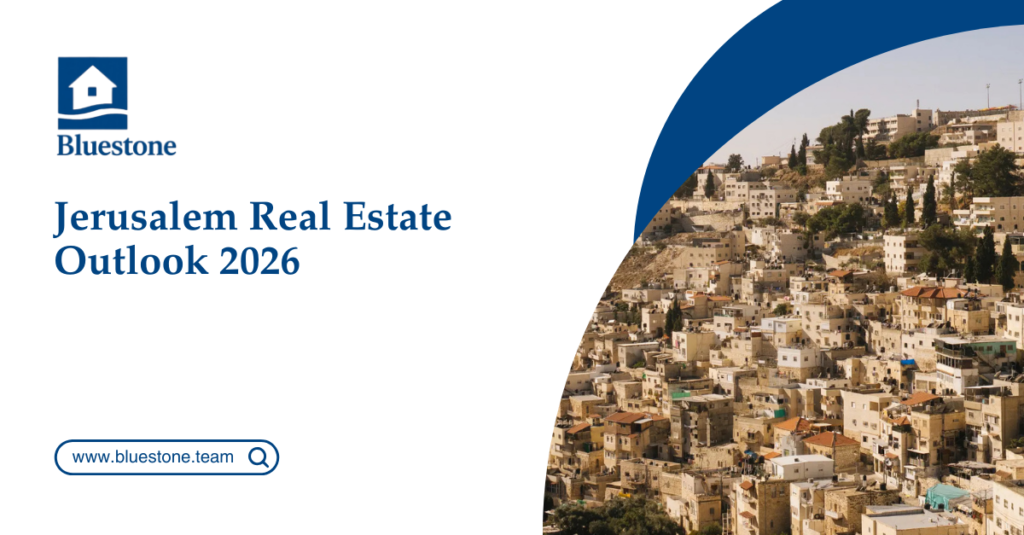
Jerusalem Real Estate Outlook 2026
What Buyers and Investors Need to Know
Jerusalem continues to occupy a singular position within Israel’s real estate landscape. Unlike markets driven primarily by economic cycles or speculative demand, Jerusalem property values are shaped by history, identity, scarcity, and a deeply rooted emotional connection to ownership. As 2026 unfolds, buyers and investors are entering a market that emphasizes stability and long term value rather than rapid volatility.
While Israel’s broader housing market has shown signs of moderation in recent years, Jerusalem remains one of the country’s most resilient districts. Infrastructure investment, easing financing conditions, and sustained domestic and international demand continue to support property values. For buyers willing to take a long term perspective, Jerusalem real estate offers a compelling blend of cultural significance and financial durability.
This in depth outlook examines the key forces influencing Jerusalem real estate in 2026. It explores market trends, price forecasts, neighborhood dynamics, infrastructure developments, rental conditions, and strategic considerations for both local and international buyers seeking clarity in a complex yet rewarding market.
Why Jerusalem Real Estate Behaves Differently
Jerusalem does not function like a typical metropolitan housing market. Ownership is often motivated by legacy, heritage, and long term connection as much as by financial considerations. This creates a buyer base that is less sensitive to short term fluctuations and more focused on enduring value.
One of the most important structural supports for Jerusalem property prices is limited land availability. Geographic constraints, preservation requirements, and strict zoning regulations significantly restrict new construction. Even as demand increases, supply expands slowly, creating persistent upward pressure on prices.
Demand in Jerusalem is also highly diversified. Local families, religious communities, government employees, students, and international buyers all participate in the market. This diversity helps stabilize pricing during periods when certain buyer segments temporarily slow.
Jerusalem’s role as Israel’s capital further strengthens demand. Government ministries, major hospitals, universities, and cultural institutions provide stable employment and consistent housing needs. This institutional presence insulates the market from broader economic volatility.
These characteristics explain why Jerusalem has consistently outperformed many other regions during periods of national housing market cooling.
Market Trends Shaping Jerusalem Real Estate in 2026
Strong Demand Despite National Market Moderation
Across Israel, housing growth has slowed compared to the rapid expansion seen earlier in the decade. Rising interest rates and affordability constraints have reduced transaction volumes in several districts. Jerusalem, however, has continued to demonstrate relative strength.
Recent reporting indicates that Jerusalem recorded one of the highest annual housing price increases among Israel’s major districts, reinforcing its position as a resilient market even as broader conditions softened, as reported by the Jerusalem Post in its analysis of housing price growth trends.
This resilience reflects fundamental demand rather than speculative activity. Buyers in Jerusalem tend to be long term oriented, which limits the likelihood of sharp corrections.
International demand remains a critical component. Buyers from North America, the United Kingdom, and France continue to view Jerusalem as a secure long term asset and a meaningful personal investment. Jerusalem’s appeal as a store of value has been highlighted in broader analysis of the city’s growing property potential by Downbeach.
Interest Rates and Buyer Confidence
Mortgage conditions play a significant role in shaping buyer sentiment, particularly among local residents and long term investors. As 2026 progresses, signals from the Bank of Israel suggest a more supportive interest rate environment compared to previous years.
Improved borrowing conditions are gradually restoring buyer confidence. End users who delayed purchases due to affordability concerns are re entering the market, while investors are reassessing opportunities with a more favorable cost of capital. This trend aligns with broader price forecasts and market analysis outlined by Sands of Wealth.
Foreign buyers are also benefiting from increased awareness of mortgage options available to non residents. Greater transparency around financing has reduced friction and expanded the pool of active international purchasers.
While interest rates remain an important variable, they function more as a catalyst than a core driver in Jerusalem’s market, where demand fundamentals remain strong.
Infrastructure as a Growth Catalyst
Infrastructure development is one of the most powerful forces shaping Jerusalem real estate in 2026. Transportation projects are redefining how buyers evaluate neighborhoods and long term livability.
The expansion of Jerusalem’s light rail system is particularly influential. New lines and extensions are improving connectivity between residential areas, employment centers, and commercial districts. Neighborhoods located near current and future stations are already experiencing increased buyer interest.
Improved accessibility expands the pool of potential buyers and supports long term appreciation. The relationship between infrastructure investment and property values in Jerusalem has been examined in detail by Sands of Wealth in its analysis of transportation driven price trends.
Infrastructure improvements are especially impactful in neighborhoods undergoing broader transformation, where transportation access coincides with new development and urban renewal.
Jerusalem Price Forecasts for 2026
Moderate and Sustainable Appreciation
Most market analysts expect Jerusalem home prices to continue rising through 2026, though at a more measured pace than in previous years. Current forecasts suggest average price growth of approximately three percent across the city, according to Sands of Wealth.
This level of growth reflects a balanced market supported by strong demand and limited supply rather than speculative excess.
Certain neighborhoods are positioned to outperform the citywide average. Areas benefiting from urban renewal projects, improved transportation access, or heightened international demand may experience stronger appreciation.
Downside risk remains limited. Even under more conservative scenarios, supply constraints and structural demand are expected to prevent significant price declines.
Asking Prices and Transaction Reality
Negotiation dynamics in 2026 show subtle shifts compared to earlier years. Buyers may encounter increased flexibility on asking prices in certain segments, particularly for properties that require renovation or lack modern amenities.
However, well located and renovated properties continue to command premium pricing and attract swift interest. Data on current transaction conditions outlined by Sands of Wealth.
This divergence underscores the importance of property selection. In Jerusalem, location and condition remain decisive factors regardless of broader market trends.
Jerusalem Compared to the National Market
National housing data indicates that Israel’s overall market is growing more slowly than earlier in the decade. Jerusalem’s continued strength reinforces its role as a relative outperformer among major cities, as reported by the Jerusalem Post.
This performance gap highlights Jerusalem’s unique demand drivers and scarcity dynamics. For investors prioritizing stability and long term appreciation, this distinction is critical.
Neighborhood Analysis, Where Buyers Are Focusing in 2026
Established Prime Neighborhoods
Central and historically prestigious neighborhoods remain among the most sought after in Jerusalem. Areas such as Rehavia, Talbiya, the German Colony, and Baka continue to attract strong interest from both local and international buyers.
These neighborhoods offer walkability, architectural character, proximity to cultural institutions, and strong resale demand. Supply in these areas is extremely limited, supporting long term value retention.
International buyers are particularly active here, often viewing properties as legacy assets rather than income generating investments. An overview of prime Jerusalem neighborhoods and their appeal has been detailed by Downbeach and Jerusalem Real Estate.
Urban Renewal Hotspots
Urban renewal continues to reshape several parts of Jerusalem, creating opportunities for buyers seeking long term upside. Pinui binui projects are replacing aging buildings with modern developments that meet contemporary living standards.
Neighborhoods such as Kiryat HaYovel, Katamonim, Armon HaNatziv, and the Pat Junction corridor are undergoing significant transformation. These areas benefit from new construction, improved infrastructure, and enhanced public spaces.
Price momentum in renewal zones has been highlighted in market analysis by Sands of Wealth. Buyers who enter early in these neighborhoods may benefit from appreciation as projects mature.
Emerging Value Areas
Neighborhoods such as Arnona and Talpiot are increasingly attracting buyers seeking relative value while maintaining strong long term growth prospects. Proximity to employment hubs and transportation routes has increased their appeal.
Once considered peripheral, these areas are evolving as infrastructure improves and development activity expands. Insights into emerging Jerusalem neighborhoods have been outlined by Jerusalem Real Estate.
Rental Market Conditions in Jerusalem
Jerusalem’s rental market remains active, particularly in central neighborhoods and areas near universities, hospitals, and government institutions. Demand is driven by students, young professionals, and short term international residents.
Rental yields, however, tend to be modest relative to purchase prices. Jerusalem is best characterized as a capital appreciation market rather than a high cash flow investment destination. This dynamic has been discussed in rental market analysis by Sands of Wealth.
Investors who prioritize long term holding and tenant quality are generally best positioned in this environment.
Strategic Takeaways for Buyers and Investors in 2026
- Jerusalem in 2026 is particularly well suited for buyers and investors with a long term perspective.
- Long term investors benefit from scarcity driven appreciation and market resilience.
- Lifestyle buyers gain stability, cultural connection, and enduring value.
- International buyers access a market that combines emotional significance with strong fundamentals.
- Success in Jerusalem real estate depends less on timing the market and more on selecting the right property in the right neighborhood with informed guidance.
Final Thoughts on Jerusalem Real Estate in 2026
Jerusalem’s real estate outlook for 2026 points to continuity and resilience. Measured price growth, neighborhood specific opportunities, and sustained global demand continue to define the market.
Infrastructure expansion, improving financing conditions, and enduring international interest support confidence even as national trends remain mixed.
For buyers and investors prepared to focus on quality, location, and long term value, Jerusalem remains one of Israel’s most compelling and durable real estate markets.
You Might Also Be Interested
Browse and read more of Bluestone Insights
Jerusalem Real Estate Outlook 2026 What Buyers and Investors Need to Know Jerusalem continues to…
Inside Jerusalem’s Resilient Real Estate Market Even in Tough Times Jerusalem’s real estate market has…